DYNAMIC MODELS OF INFRASTRUCTURE BEHAVIOR
Warning and prevention of infrastructure failures
CURRENT CHALLENGES IN OPERATING PHYSICAL ASSETS
The infrastructure around us was built mostly in the 1950s–1970s — and as it ages, the risks of operating it rise noticeably. These risks are compounded by a shortage of highly qualified specialists in the engineering and technical field.
Digital modeling of infrastructure failure makes it possible to increase the reliability, safety and efficiency of operation several times over
As a result of the work, the likely place and time of failure of each infrastructure element will be identified — and an optimal program of use and repair will be drawn up
TYPES OF MODELED INFRASTRUCTURE
The technology is used to create digital twins of the life cycle of buildings and structures: their working loads, design, materials and operating conditions.
A unique feature is the streaming processing of large volumes of data — using the technology on some of the world's largest infrastructure has produced strong results.
The technology makes it possible to reduce failure rates and the unit cost of owning infrastructure by a factor of 2 to 10.
PURPOSE AND FEATURES
The technology is designed to monitor, assess, analyze, forecast and program the condition of infrastructure

ATTENTION TO DETAIL
Element-by-element detailing of the digital twin accounts for individual structural elements, their connections, and their operating conditions. This makes it possible to achieve high accuracy in identifying the place and time of failure based on deviations of actual values from the theoretical indicators of strength and durability.

KNOWLEDGE INTEGRATED INTO A SINGLE FIGURE — TIME TO FAILURE
The content of the digital twin is enriched with data streams: monitoring of the linear and angular accelerations experienced by the structure, previously studied defects and records of actions taken, constant and variable working loads, and the state of the environment.

DATA
The digital twin is enriched with data streams: constant and variable operating load; previously known defects and the measures taken; monitoring of linear and angular acceleration.

EARLY WARNING
The digital twin makes it possible to detect and prevent the emergence of critical and/or "bottleneck" areas that reduce the reliability and safety of a specific infrastructure asset at every stage of its life cycle.
ORDER OF WORK
01Collection and digitization of infrastructure documentation
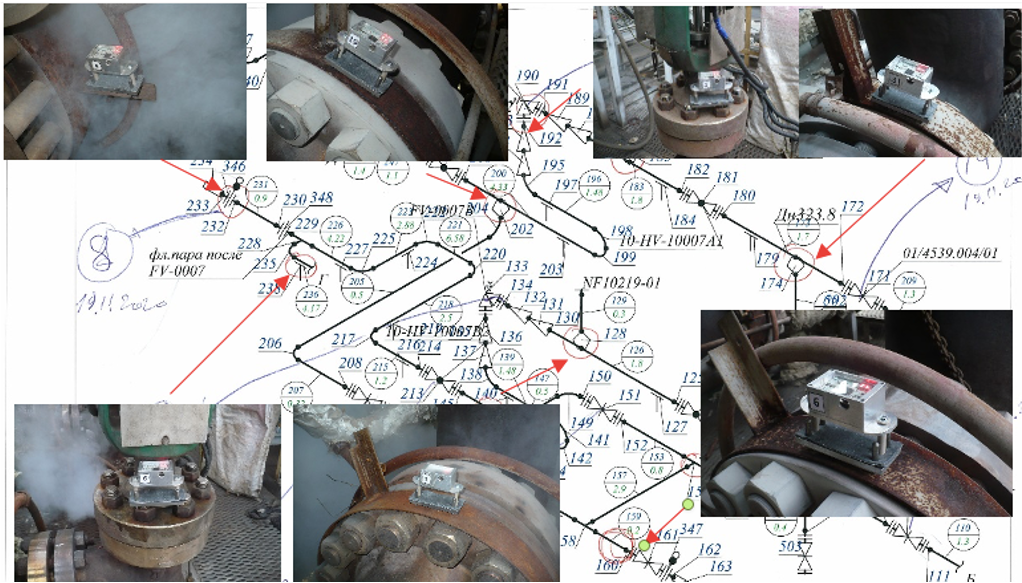
02Instrument measurements at control points
03Strength and durability calculations for infrastructure elements
04Report on the places and times of failure. 7D model
The result of collecting and digitizing the documentation is a digital log of elements and their structural connections.
The electronic log is a simple spreadsheet in MS Excel format, with good readability and editability and ready for further machine processing.
COLLECTION AND DIGITIZATION OF DOCUMENTATION
Conversion to electronic form
Paper diagrams
The source information may be design documentation that has survived only on paper. These are often standard structural designs.
Conversion to a standard format
Electronic diagrams
Preliminary analysis and construction of a mathematical model of the "ideal" structure. Assessment of the expected loads and stresses; deviations from them during actual measurements will provide useful information about the discrepancy between the design and actual condition of the asset (unauthorized breaches of pipe integrity, damage, etc.).
Digitization of defects and actions
Operating logs
The technology is not merely a method of flaw detection. Its purpose is to integrate data on structural elements and past/existing defects into a single model with many applications: from ranking risks by degree of danger to reducing the unit cost of operation.
Selecting measurement locations
Control points
To determine the actual condition of structural elements, instruments are used that record linear and angular displacements. Data on actual displacements is collected selectively at control points of the structure (at branch points). The displacements of all structural elements are then reconstructed from these points.
Splitting for calculation
Structure diagram
For complex branched structures, splitting into several sections can be used to speed up the calculations. This division does not compromise the integrity of the assessment of the behavior of the structure as a whole.
Visualization of elements
Initial 3D model
One of the results of digitizing the structure is its initial visualization. A dedicated program has been developed for this purpose. Its distinctive feature among BIM modeling programs is the open and documented specification of the digital-twin model (a file with tabular data) of the asset's structure, as well as accounting for connections and defects.
STRENGTH AND DURABILITY CALCULATIONS
The main part of the work consists of integrating the measurement results and structural diagrams into a continuously operating mathematical model of the asset (the digital twin), whose objective function is to determine the place and time of failure of each structural element
Final report
An element-by-element presentation of the assessment of physical wear, the timing and types of diagnostics and repair.
Calculation of the amplitude-frequency characteristics of the control points
Based on the instrument measurements, the spectra of displacements and rotation angles of the control points are reconstructed. Digital signal processing algorithms: Laplace transform, spectral analysis methods (B. Gold, C. Rader, R. Lyons, L. M. Goldenberg, A. B. Sergienko, et al.).
Distribution of displacements, rotation angles, torques and forces along the length
Algorithms for calculating beams on an elastic foundation, adapted for the structure (A. N. Krylov, V. I. Feodosyev, Yu. N. Rabotnov, et al.).
Calculation of the stress-strain state
Classical and modern algorithms for calculating the stress-strain state, accounting for stress concentration (V. I. Feodosyev, Yu. N. Rabotnov, the work of the welding technology departments of LPI, Bauman MSTU, ChPI, the E. O. Paton Electric Welding Institute, et al.).
Calculation of failure rates
The local-stress method is used — an engineering theory of strength and durability.
Calculation of maximum service life before repair
Integration of the frequency and cyclicity of stresses.
FINAL REPORT AND 7D MODEL
The result of the work is an interactive report with conclusions and a digital twin of the asset in the form of an open tabular file containing the dynamic characteristics of the structure, together with a dedicated viewer for visualizing it.
STRUCTURE OF THE FINAL REPORT AND CONCLUSIONS

Introduction
Includes the grounds and subject of the failure assessment. The objective of the work. The actual stages of the work. Information on the source data.

Measurement data
The time and locations of the measurements. Supporting documents.
Asset diagram
Spatial model. Element-by-element log. Statistics by type of element.
Calculation procedure
Division into calculation sections. The procedure and results of the calculation.

Conclusions
Assessment of failure rates. Physical wear and rate of aging. Maximum repair deadlines. Ranking of elements by degree of danger (failure risk).

Recommendations
Conclusions on the causes of failure of structural elements. Types of advisable operating measures. An operation and repair program.
Examples of infrastructure digital-twin visualizations
Explanation of the 4D model of a process pipeline
Thin line — the design position of the pipeline. Thick line — the actual vibration. Grey bars mark the supports. Yellow dots mark the points where measurements were taken. Grey lines mark the bearings.
We invite everyone interested in improving the reliability and safety of infrastructure to work with us